
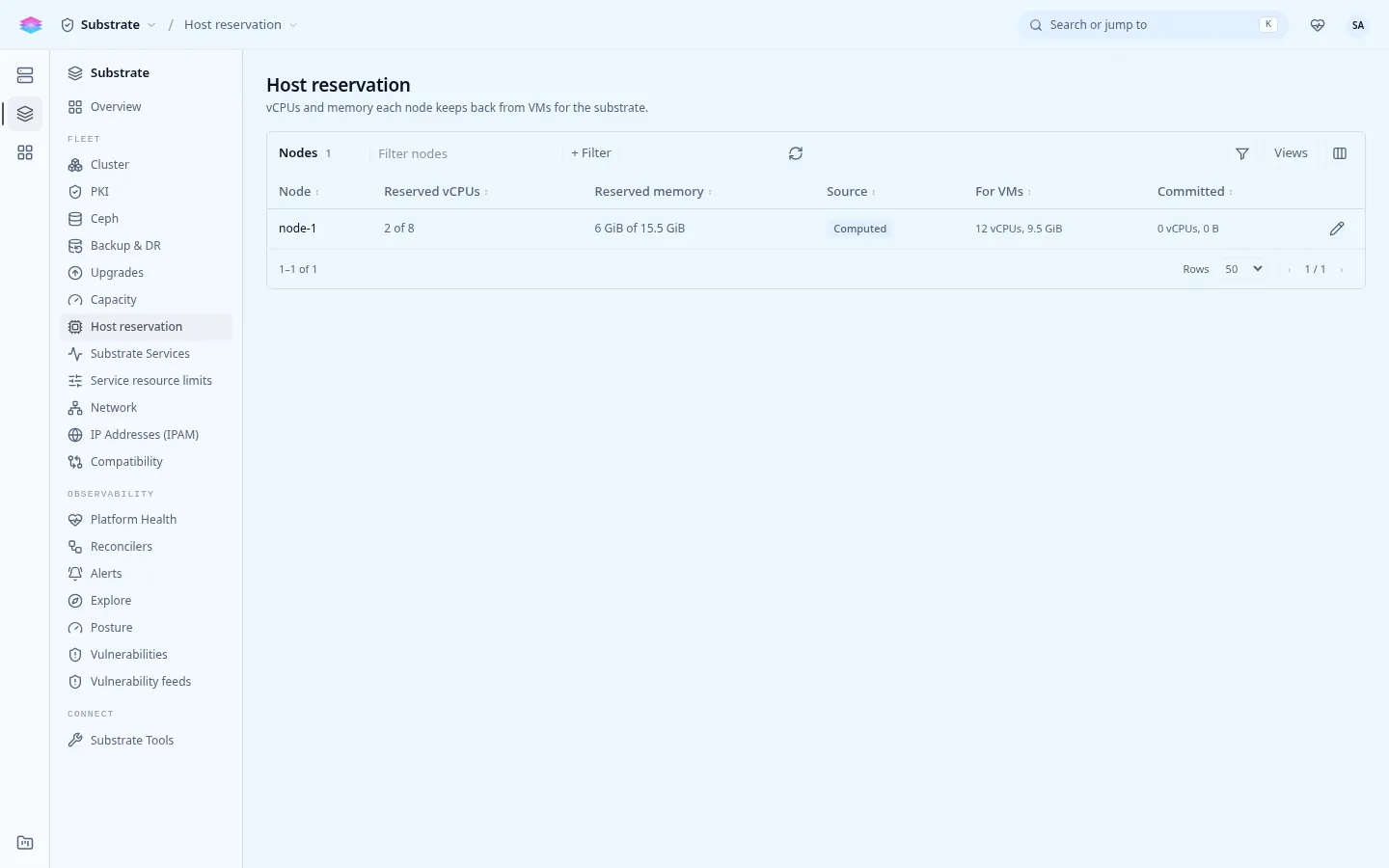
Host reservation
Every node keeps vCPUs and memory back from instances for the platform itself: the kernel, the control plane, the database and the monitoring stack. A single node computes it from its size:
| Default | |
|---|---|
| Memory | max(6 GiB, 10% of RAM) |
| vCPUs | max(2, 6% of the CPU threads) |
The reservation is enforced. The platform’s memory is protected from instances, and instances together are capped at RAM minus the reservation. Instances get what is left, multiplied by the overcommit ratio: (total − reserved) × overcommit.
Change it
Section titled “Change it”Console: Admin › Substrate › Host reservation.
stratumctl nodes get n-abc123 # Reserved and Allocatablestratumctl nodes set-reservation n-abc123 --vcpus 4 --memory-gib 12stratumctl nodes set-reservation n-abc123 --computed # back to the defaultA value set this way is kept until changed again. The floor is 1 vCPU and 4 GiB, for development machines only; anything above the node’s total is refused.
When to raise it
Section titled “When to raise it”| Finding | Means | Do |
|---|---|---|
SubstrateNearReservation |
The platform uses more than 90% of its reserved memory. | Raise the memory reservation. |
NodeCommittedOverAllocatable |
A raised reservation left less room than instances already hold. Nothing running is moved; new instances stop landing on the node. | Stop or resize instances, or lower the reservation. |
stratumctl nodes capacity shows how many more instances of each type fit after
the reservation.